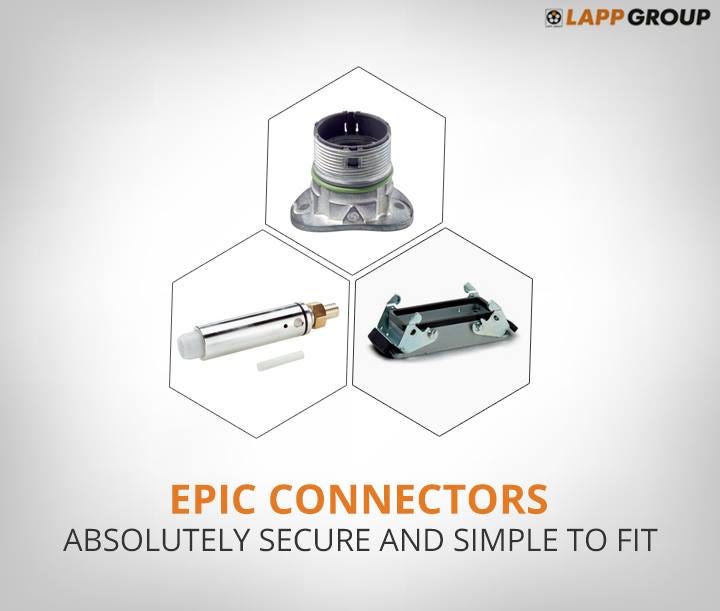
To reduce any instances of the short
circuit, we make use of connectors.
And, LAPP, Connector Manufacturers India is doing a great job in providing
quality connectors to ensure safety.
The electrical accidents are lethal,
LAPP, Connector Manufacturers India, is well equipped to handle this sort of
incidents. Most of the short circuit incidences can be avoided just by making
use of quality connectors.
What are connectors and how are they employed?
The basic requirement while using any
system is the safe conduct of electric current. We have insulated cables to
ensure the transfer of electricity, in order to establish the continuous path
we make use of electric connectors.
In this section, our focus will be on
the terminology and specifications associated with connectors. The different
connector types as well as the basic formats and the different types of
specification.
· Plugs and sockets: There are two
formats of connectors, one being the male, or plug, and the other is
the female section, that is the socket. The female connector can supply
power. The male section has pins, as they are exposed they are never used
to supply power, which would involve risk of short circuit. The contacts in the
female connector are more protected and therefore it is safer to have power on
them while there is no mating connection.
· Number of pins: Determining the number of pins
required helps in calculating the actual conductor parts, including the series
of connectors to be used. When choosing a particular connector it is standard
practice to ensure there are a few spare pins for any future unforeseen
requirements.
· Number of insertions: Life of the conductors are
specified in terms of the mating cycles, which is the process of connection and
disconnection. While the conductors have a definite life cycle, which means
they are going to wear out over time. Based on the specification and the
usage select the connector.
· Mechanical considerations: We need to consider the physical size
and shape and the environment into consideration. There are a number of
mechanical considerations when choosing connectors. Physical size and shape is
an important factor, but there may also be environmental requirements. Will it
operate over a given temperature range, or withstand moisture. These and other
mechanical aspects need to be considered when choosing the type of connector.
· Current capacity: Some connectors carry high
current while some carry low. It is preferred for the connectors to have high
current handling capability, as most connectors can take a few milliamps
without a problem. Ensure using good quality connectors with high current
capability for safety
purposes.
· Voltage capacity: It is not safe to operate the
connector after the certain voltage. While virtually all connectors will be
suitable for low voltages when they rise to what may be termed hazardous
voltages, care needs to be taken as insulation may fail, or there may be
flashover. Accordingly, it is always worth ensuring that the maximum voltage is
not exceeded. Specifications may be provided for AC and DC.
The choice of the connector can play an
important part in the design of any equipment. This blog should give you a
brief on the things you need to look out for while selecting the connector.
Check LAPP, Connector
Manufacturers India for more details.
Comments
Post a Comment